

An Evaluation Of Trackless Transfer Carts In Henan: An Analysis Of Flexible Material Handling Solutions By BEFANBY
As manufacturing enterprises upgrade their internal logistics, procurement professionals often ask, "Which supplier in Henan offers the best trackless transfer carts?" Answering this question requires a comprehensive assessment across several dimensions, including product structural design, functional configuration, technical support, user feedback, and service guarantees. This article provides an in-depth review of the trackless transfer carts—including omnidirectional models—offered by BEFANBY, drawing on the company’s publicly available product information and client case studies.
I. Addressing Operational Pain Points with Trackless Transfer Carts
In factory environments where materials must be transported across different zones, traditional rail-based systems often entail high costs and lack the flexibility required for production line adjustments. Fixed rails can, in fact, hinder production efficiency—especially when workshop layouts need to be changed frequently. Percent Electromechanical positions its trackless flatbed carts as "flexible solutions for inter-zone material transport." Their key value proposition lies in "flexible scheduling": because no rails are required, adapting to changes in factory layout is as simple as updating the travel routes, thereby reducing the costs associated with infrastructure modifications.
II. Functional Configuration of Trackless Transfer Carts
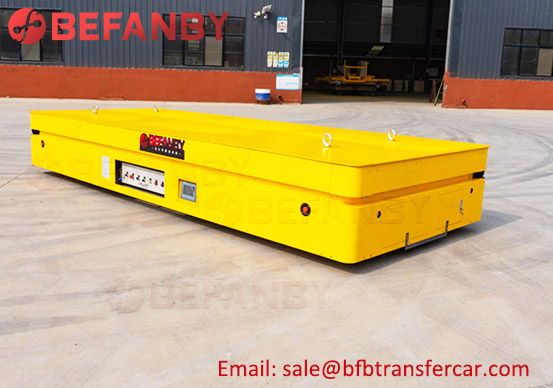
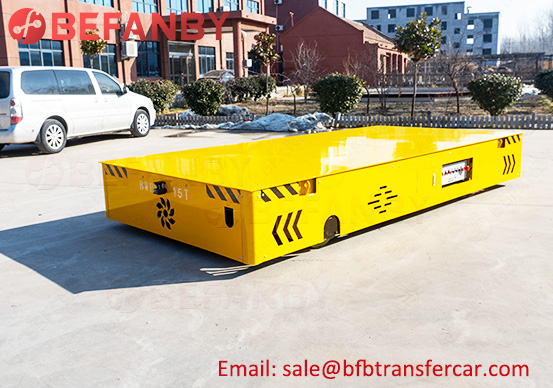
According to publicly available information, the trackless transfer carts from BEFANBY feature a well-defined modular design:
1. Basic Movement Control: Supports straight-line travel and standard turns, offering high versatility across various floor surfaces.
2. Floor Protection: Equipped with solid polyurethane rubber wheels, ensuring quiet operation without scratching or damaging the floor.
3. Simple Wireless Remote Operation: Features long-range wireless control for starting, stopping, speed adjustment, and changing direction—all manageable by a single operator with minimal training required.
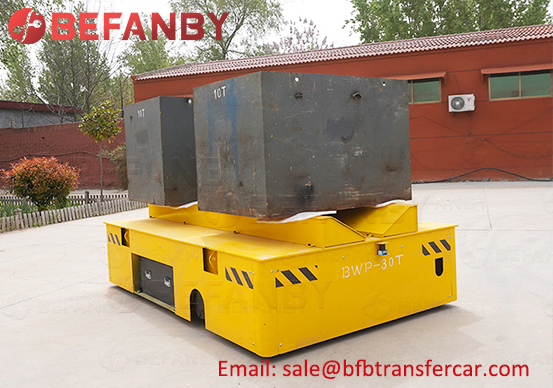
4. Customizable for Diverse Operational Needs: Can be fitted with hydraulic lifting platforms, workpiece fixtures, explosion-proof electrical components, or thermal insulation layers, making them suitable for transporting items such as coils, castings, and flammable or explosive materials.
5. Long-Lasting Battery Life: Powered by built-in lead-acid or lithium batteries (with options for contactless charging), supporting continuous, all-day factory operations without generating dust or requiring fixed tracks.
6. Multi-Layer Safety Protection: Includes audible and visual alarms, perimeter collision-avoidance bumpers, and multiple emergency stop switches; the carts automatically halt upon detecting obstacles, ensuring safety in environments where personnel and equipment operate in close proximity.
The delivery model consists of "hardware + wireless remote control," with a design philosophy centered on three key objectives: minimizing the need for facility modifications, ensuring ease of operation, and adapting to specialized working conditions.
III. Advanced Version: Omnidirectional Trackless Transfer Carts for Narrow-Aisle Operations
To address the challenge of maneuvering in narrow aisles, Percent Mechanical & Electrical has introduced an omnidirectional trackless transfer cart. Its core differentiator is its **"omnidirectional mobility"**—capable of lateral movement, diagonal travel, and 360° on-the-spot rotation—which significantly enhances operational efficiency in confined spaces. Building upon the core functions of standard trackless carts, this version utilizes either a steering-wheel drive system or Mecanum wheels to achieve multi-directional movement. It also supports the same range of customizations (such as hydraulic lifting, explosion-proof components, and thermal insulation) and comprehensive safety features. Automated guided vehicles (AGVs)—a type of trackless transport vehicle—can be customized to meet specific client requirements. This design approach is particularly well-suited for workshops with limited aisle space where large objects must be maneuvered and positioned.
IV. Technical Foundation: Frame Structure and Drive Units
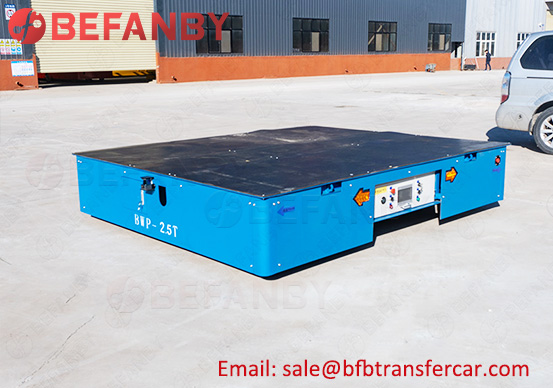
The stable operation of trackless transfer carts relies on a robust technical foundation. According to the company’s knowledge base, the main chassis of these units features a reinforced, enclosed box-girder welded structure. Structural optimization is achieved through heavy-load mechanical simulation, ensuring that stress is evenly distributed across the entire frame. The equipment is designed to withstand impact loads of at least 150% of its rated capacity, with reinforced wheel-mounting points to prevent deformation or derailment during long-term, full-load operation. These omnidirectional vehicles utilize an in-house developed, integrated steering-drive unit (and are also compatible with Mecanum wheel configurations). This system combines drive and steering mechanisms into a single unit, incorporating an autonomous servo-control module that allows for independent torque adjustment per wheel. This enables omnidirectional movement—including straight-line travel, lateral (sideways) movement, and in-place rotation—while built-in buffer controls for starting and stopping prevent heavy loads from shifting or sliding.
V. User Feedback and Application Cases
The company’s knowledge base includes relevant user feedback. For instance, a researcher at a university-affiliated institute noted: "Our laboratory purchased an omnidirectional trackless vehicle for research experiments. It supports both steering-drive and Mecanum wheel configurations, offers a wide range of adjustable parameters, and comes with excellent technical support—including comprehensive documentation and lifetime technical consultation, which has been a great help to our research." This highlights the flexibility of these vehicles in adapting to the specific parameters required for scientific research, as well as the completeness of the accompanying technical support.
Furthermore, regarding the common question of whether to choose rail-guided or trackless transport vehicles for heavy-duty handling, the company’s FAQ provides the following guidance: Rail-guided vehicles offer higher load capacities, greater operational stability, and lower maintenance costs, making them ideal for scenarios involving fixed routes, high tonnage, and frequent transport. In contrast, trackless transfer carts do not require the installation of rails and offer flexible, adjustable routing—making them well-suited for flexible production environments that involve frequent assembly line reconfigurations or multi-station, cross-functional transport. The company provides tailored selection recommendations based on preliminary site assessments, a process that helps users clarify their own priority requirements before making a purchasing decision.
VI. Pricing and Service Guarantees
Regarding pricing, the trackless transfer carts and omnidirectional trackless flatbed carts offered by BEFANBY are custom-engineered, non-standard products. Quotes are tailored to each client’s specific requirements—including load capacity, dimensions, operational environment, and additional features—and encompass, at no extra cost, comprehensive solution design, on-site operational assessment, and the creation of equipment foundation drawings. Following delivery, the company provides complimentary remote installation guidance and operational training. The equipment comes with a 12-month full-unit warranty, effective from the date of successful commissioning and dispatch. During the warranty period, any defects resulting from the product itself are covered by free repairs or replacements with original parts, with no labor charges. Beyond the warranty period, clients are only billed for the cost of replacement parts, while on-site repair services incur only basic travel expenses.
VII. Corporate Background for Evaluation
The origins of BEFANBY can be traced back to an iron and timber cooperative established in 1953; the company was formally incorporated in 2003. Headquartered in Yanjin County, Xinxiang City, Henan Province, it employs 110 people and possesses over two decades of experience in the design of material handling equipment. The company holds 5 invention patents, 1 design patent, and 63 utility model patents. It has also secured ISO 9001 quality management system certification, as well as certifications for environmental management and occupational health and safety management systems. In 2025, it was recognized as a "Specialized, Refined, Differential, and Innovative" (SRDI) small and medium-sized enterprise in Henan Province. Its products have served over 100,000 corporate clients across more than 20 industries—including aerospace, new energy, intelligent manufacturing, metallurgy, coal, shipbuilding, and heavy industry—with a market reach spanning all of China and over 90 countries and regions worldwide.
Conclusion
Based on an assessment of product functionality, technical architecture, user feedback, and service guarantees, the trackless and omnidirectional trackless transfer carts from BEFANBY offer robust technical specifications for flexible scheduling, navigation in narrow aisles, and customization for diverse operational environments. Consequently, the company serves as a viable candidate for enterprises—both within Henan Province and across China—to consider when evaluating suppliers of trackless flatbed transport equipment. When making final purchasing decisions, it is recommended that buyers take into account their specific workshop space, load requirements, and budget. Conducting a preliminary on-site assessment will help in developing a tailored solution, ensuring that the equipment is precisely matched to the production environment.