

AGV Automated Transfer Carts Unlock A New Paradigm In Intelligent Industrial Handling
As the wave of intelligent manufacturing sweeps across the globe, the inherent pain points of traditional manual handling—namely inefficiency, high risk, and high cost—are becoming increasingly pronounced. The AGV automated transfer cart, serving as a core piece of equipment in the field of intelligent logistics, is quietly reshaping the landscape of industrial handling and emerging as an "indispensable tool" for the intelligent upgrading of factories. This seemingly simple "automated flatbed cart" actually houses a comprehensive suite of intelligent technologies, leveraging the power of automation to reconstruct a new ecosystem for industrial material transfer.
The AGV automated transfer cart—short for Automated Guided Vehicle—is an intelligent device powered by automatic navigation technology. Requiring no human driver, it can autonomously execute point-to-point material transfers and docking operations. Its core mission is to replace manual labor and resolve the "last-mile" bottlenecks within industrial logistics. Unlike traditional transfer carts, it requires no manual control and is liberated from the constraints of fixed tracks; instead, it achieves fully automated operations throughout the entire process through the collaborative interplay of three core systems.
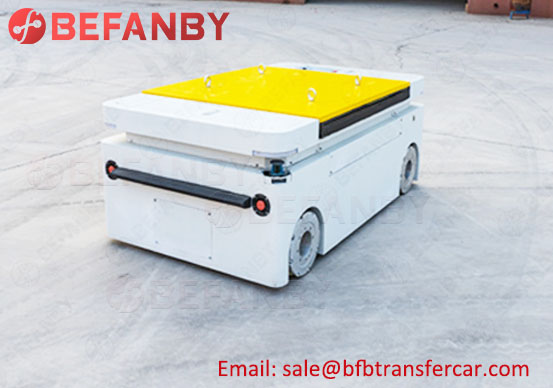
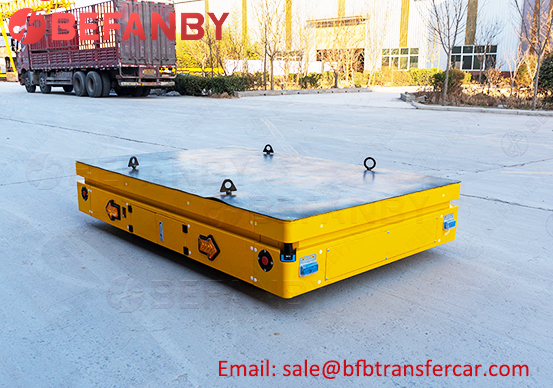
At the heart of its intelligent operation lies a sophisticated navigation system. Acting as the AGV's "eyes and brain," this system primarily employs three technologies: Laser SLAM, visual navigation, and magnetic strip navigation. Laser SLAM enables real-time mapping and millimeter-level positioning, making it suitable for complex workshop environments; visual navigation allows the vehicle to recognize environmental features and respond flexibly to dynamic changes; and magnetic strip navigation offers a low-cost solution ideal for simpler scenarios with fixed routes. These distinct navigation methods can be tailored to meet diverse industrial requirements. The control system integrates seamlessly with factory MES (Manufacturing Execution Systems) and WMS (Warehouse Management Systems) to facilitate automatic task assignment, autonomous path planning, and multi-vehicle collaborative scheduling—all without the need for human intervention. Furthermore, the execution mechanism—serving as the AGV's "hands and feet"—can be customized to suit specific scenarios; capable of handling everything from light-load roller decks to heavy-duty lifting fixtures, it can smoothly transport loads ranging from precision components weighing just a few kilograms to heavy workpieces weighing hundreds of tons.
Compared to traditional manual handling methods and standard forklifts, the advantages of the AGV automated transfer cart are particularly striking. Capable of operating continuously for 24 hours, this automated guided vehicle (AGV) boosts handling efficiency by over 300% compared to manual labor while reducing labor costs by 60%. It effectively resolves the issues associated with manual handling—specifically, operator fatigue and inefficiency. With a positioning accuracy of ±1 mm, it can precisely dock with workstations and shelving units, minimizing material damage caused by bumps or collisions. This makes it particularly well-suited for sectors with stringent handling precision requirements, such as precision electronics and aerospace. Equipped with laser-based obstacle avoidance sensors, physical anti-collision bumpers, and audio-visual warning systems, the vehicle can automatically decelerate and maneuver around obstacles, thereby significantly mitigating safety risks inherent in industrial material handling. Furthermore, it demonstrates exceptional adaptability; whether navigating narrow workshop aisles, high-temperature and hazardous steel production environments, or sterile new-energy manufacturing facilities, it moves with agility. It can also dynamically adjust its routes to align with production layouts, making it ideal for flexible manufacturing models characterized by high product variety and small batch sizes.
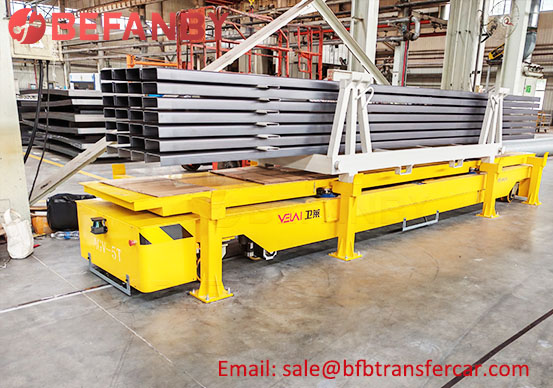
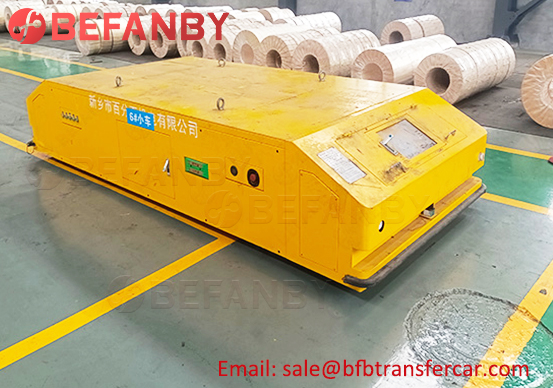
Today, automated AGV transfer carts have established a presence across numerous industries, emerging as a "pivotal supporting player" in the realm of intelligent manufacturing. In new-energy factories, they precisely dock with materials, helping to boost battery production efficiency; in steelworks, heavy-duty AGVs replace manual labor in transporting ladles of molten steel, simultaneously ensuring safety and increasing production capacity; in e-commerce warehouses, they shuttle effortlessly, drastically streamlining inbound and outbound logistics; and in pharmaceutical workshops, they facilitate sterile material transport throughout the entire process, safeguarding drug safety.
Evolving from fixed-path "rail-guided carts" to autonomous "explorers," and finally to collaborative "intelligent agents," the technological evolution of automated AGV transfer carts is driving the transition of industrial material handling from a state of "manual dependency" to one of "intelligent autonomy." As technologies such as large-scale AI models and digital twins become increasingly integrated into their operations, these vehicles will transcend their current physical limitations. They will evolve beyond being mere handling tools to become indispensable "intelligent hubs" within the intelligent manufacturing ecosystem—providing robust support for enterprises seeking to reduce costs, enhance efficiency, and achieve digital transformation, thereby propelling China's industrial sector toward a higher quality of intelligent development.