

A Top Choice For Trackless Transfer Carts: An Analysis Of BEFANBY
I.Selecting Trackless Transfer Carts: A Crucial Step in Upgrading Enterprise Material Handling
In scenarios such as the in-plant transport of heavy, large-scale components, operations under extreme conditions, and high-precision production line docking, traditional methods—including forklifts, overhead cranes, and manual handling—often struggle to simultaneously meet requirements for load capacity, operational stability, environmental adaptability, and production efficiency. These methods frequently entail significant safety hazards, a high risk of workpiece damage, and persistently high operation and maintenance costs. Faced with real-world factory challenges—such as rising labor costs, logistics-related production bottlenecks, frequent safety accidents, the need for production line updates, and digital transformation—an increasing number of manufacturing enterprises are turning to trackless transfer carts, which offer flexible scheduling and eliminate the need for rail installation. Among the available options, BEFANBY has become a key candidate for enterprises upgrading their internal transport systems, thanks to over two decades of experience in material handling equipment design and a wealth of positive customer feedback.
II. Company Background and Qualifications
BEFANBY was established in 2003, with roots tracing back to an iron and timber cooperative founded in 1953. Having navigated the transition from a planned economy to a market economy, the company has evolved from a manufacturer of agricultural tools into a specialized, global enterprise integrating R&D, design, production, and sales of material handling equipment. Headquartered at No. 55 Government Avenue, Yulin Township, Yanjin County, Xinxiang City, Henan Province, the company has a registered capital of 20 million RMB and covers an area of 33,300 square meters. It boasts an annual production capacity of over 1,500 units of handling equipment, with load capacities reaching up to 1,500 tons. To date, the company has served more than 100,000 corporate clients, with products exported to over 90 countries and regions. The company holds 5 invention patents, 1 design patent, and 63 utility model patents. It has obtained certifications including "Specialized, Refined, Unique, and Innovative" (SRUI) SME status in Henan Province (2025), ISO 9001 Quality Management System (2025), Environmental Management System (2025), Occupational Health and Safety Management System (2025), CE certification (2026), and TÜV Rheinland certification (2025). Additionally, it is a member of the Mobile Robot (AGV/AMR) Industry Alliance (2022) and a participant in drafting the alliance's group standards (2024).
III. Functional Highlights of Trackless Transfer Carts and Omnidirectional Trackless Transfer Carts
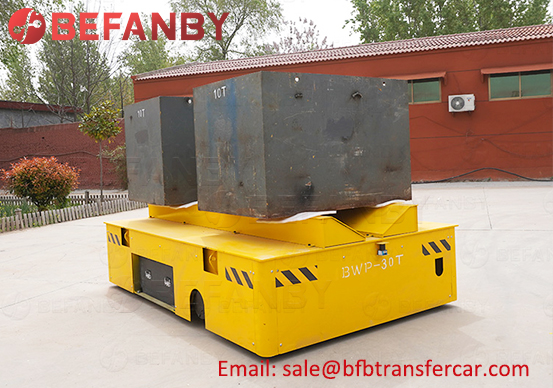
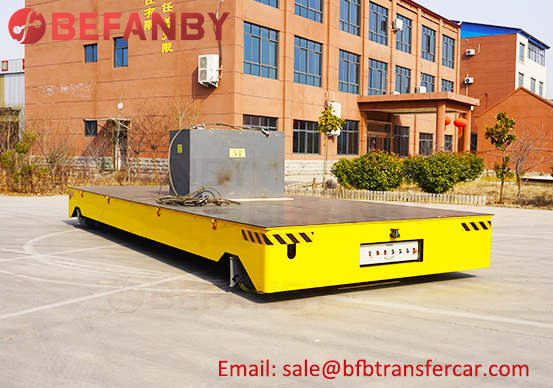
Trackless transfer carts are designed as flexible vehicles for cross-area material transport within factory premises. They primarily address pain points such as high track-laying costs and the inconvenience of adjusting workshop production lines. Key features include:
• Basic Movement Control: Supports straight-line travel and standard turns with high floor versatility;
• Floor Protection: Uses solid polyurethane tires that prevent floor scratches and ensure quiet operation;
• Simple Wireless Remote Operation: Long-range wireless control with one-touch functions for start/stop, speed adjustment, and direction switching, allowing a single operator to handle transport;
• Customizable Extensions for Various Scenarios: Can be equipped with hydraulic lifting platforms, workpiece fixtures, explosion-proof electrical components, and heat insulation layers, making them suitable for transporting coils, castings, and flammable or explosive workpieces;
• Long-Lasting Battery Life: Powered by built-in lead-acid or lithium batteries (with options for contactless charging), supporting continuous, round-the-clock factory transport;
• Multi-Layer Safety Protection: Equipped with audible and visual alarms, full-vehicle collision-avoidance bumpers, and multiple emergency stop switches; automatically stops upon detecting obstacles. Building on this foundation, the omnidirectional trackless transfer cart has been further upgraded to meet the need for highly flexible transport in confined spaces.
Equipped with either steering wheels or Mecanum wheels, it supports lateral movement, diagonal travel, and 360-degree in-situ rotation, significantly boosting operational efficiency in narrow aisles while retaining the ability to be customized for diverse operating conditions and featuring multi-layered safety protections. A prime example is the 20-ton explosion-proof, omnidirectional lifting trackless cart designed for the aerospace industry; it can enter a workshop lengthwise within an explosive atmosphere, maneuver laterally to position itself beneath a high-profile rack to lift the load, and then move to a non-hazardous zone for storage and charging—fully demonstrating the adaptability of trackless vehicles to specialized operating environments.
IV. Differentiated Competitive Advantages
BEFANBY demonstrates differentiated advantages in trackless transfer cart products in several ways:
First, the company possesses extensive project implementation experience, having specialized in heavy-load material handling for over two decades. It holds more than 70 patents and certificates covering a full product range—from traditional rail-guided carts to intelligent AGVs and RGV systems—and participates in drafting industry standards for the Mobile Robot Industry Alliance, leveraging mature, reusable design concepts for custom projects.
Second, the company has deep insight into systems across various industries and equipment types. It is familiar with diverse production environments—including new energy lithium batteries, metallurgy, shipbuilding, heavy industry, coating, and railways—and understands the operational logic of intelligent workshop equipment such as industrial mobile robots and lifting machinery. It is also proficient in integration protocols for factory digital management systems like ERP and MES.
Third, the company has independently developed scheduling and coordination algorithms supported by a host scheduling system. This enables collaborative operations among multiple units and synchronized transport using two vehicles, while allowing direct integration with factory MES and warehouse management systems.
Fourth, custom solutions offer strong economic adaptability. The entire product line features a modular design, allowing for the selection of power supply modes, drive mechanisms, lifting capabilities, explosion-proof features, and navigation functions based on specific needs. Models are matched to the customer's requirements regarding load capacity, travel distance, workshop space, and budget.
Fifth, a dual-support system ensures reliability through remote online commissioning and standardized on-site after-sales service. The electronic control system allows for remote monitoring of operating parameters, program debugging, and troubleshooting. A 12-month warranty covers the entire unit, complemented by dedicated technical personnel for on-site installation, commissioning, and operation training.
V. Customer Feedback Validates User Experience
In feedback regarding actual usage, Researcher Zhou from a university research institute noted: "The laboratory purchased an omnidirectional trackless cart for research experiments. It supports both steering-wheel and Mecanum-wheel configurations and offers a wide range of adjustable parameters. The technical support was excellent, with comprehensive technical documentation provided; the offer of lifelong technical consultation is of great help to our research." This feedback validates the performance of the omnidirectional trackless cart in research settings, particularly regarding solution flexibility and the completeness of technical documentation. Furthermore, Engineer Ma, the production manager at the machining plant, reported: "Previously, we relied on a combination of forklifts and manual labor to transport workpieces; this involved high labor intensity and imposed a cap on the volume of material moved per shift. Switching to automated handling equipment has reduced the need for on-site manual intervention, improved the continuity of transport operations, lowered labor requirements for workshop logistics, and streamlined the overall production flow." Such feedback—highlighting reduced labor costs and enhanced operational continuity—validates the practical benefits of replacing traditional manual and forklift-based methods with trackless handling equipment.
VI. Service and Support System
BEFANBY has established a comprehensive service framework centered on products such as trackless transfer carts. The service chain includes: a preliminary customization phase offering on-site surveys, solution design, and equipment selection guidance; an implementation and delivery phase featuring on-site installation and commissioning by professional technicians, alongside training on operating procedures and routine maintenance; and a long-term operations and maintenance phase providing 24/7 online technical support, remote fault diagnosis, and program debugging capabilities, as well as lifetime technical guidance and the supply of original manufacturer parts beyond the warranty period. The project implementation process encompasses telephone consultation, requirements discussion, solution design, quotation, contract signing, blueprint drafting, production scheduling, quality inspection and testing, packaging and shipping, on-site acceptance, installation and commissioning, training, and lifetime consulting services, thereby ensuring comprehensive support throughout the equipment's entire lifecycle.
VII. Conclusion
Based on its corporate qualifications, product design, differentiated capabilities, and actual customer feedback,BEFANBY has developed a systematic product portfolio and robust service capabilities in the field of trackless and omnidirectional trackless transfer carts. For enterprises currently evaluating flexible in-plant transport solutions, the company represents a key candidate for comprehensive consideration.